04 / Memory / How Jimm remembers

Memory works when each layer has a job.

A helpful AI should not force you to repeat the important parts of your work. But it should not turn every conversation into permanent personal history, either. The point is not to store everything. The point is to preserve the right context, retrieve the right record, and stay honest about what is current.

Continuity is a practice of judgment: decide what should persist, keep the source and scope visible, and leave a correction path whenever the record can be wrong.

The route

A question gets the route it needs.

Not every question needs every layer. The route changes with the question, and the source keeps its own boundary.

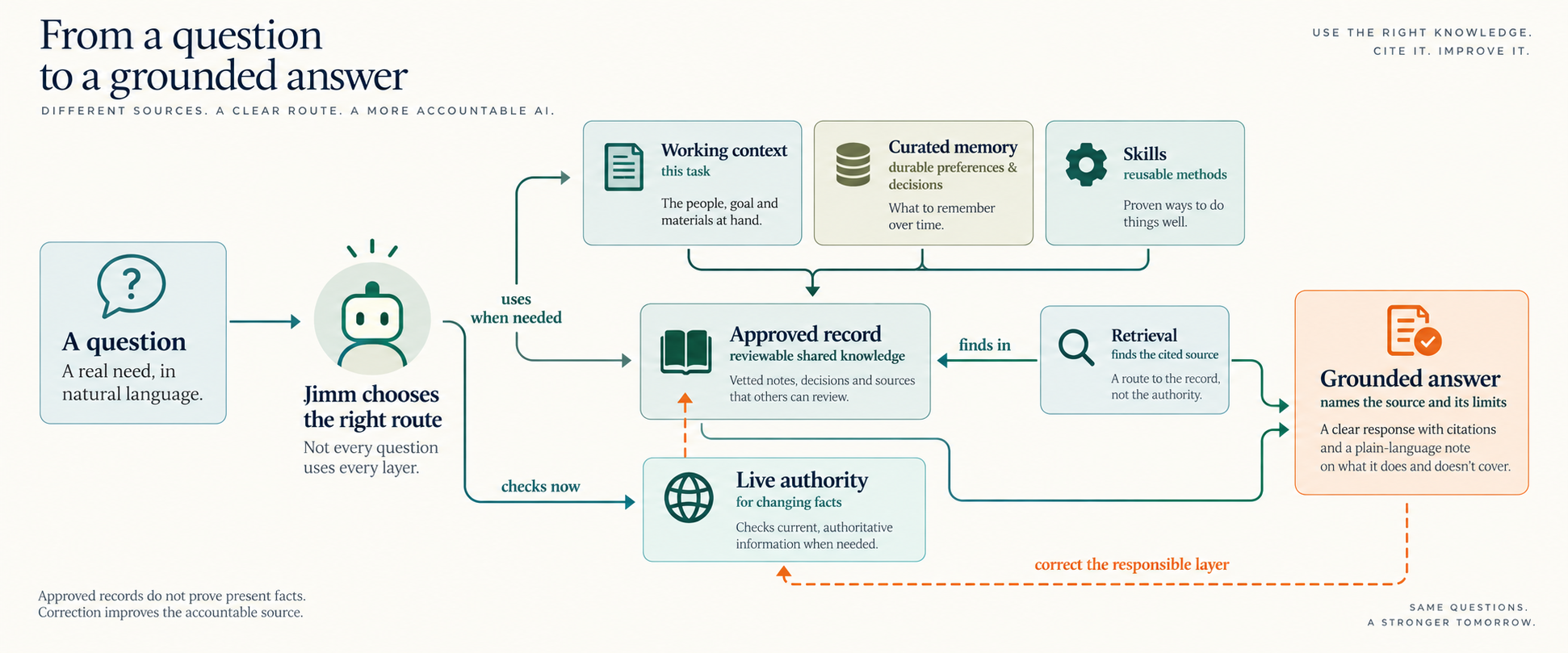
Diagram showing how a question is routed through working context, curated memory, skills, approved records, retrieval, and live authority to produce a grounded answer with citations and stated limits. A feedback loop corrects the responsible layer.
Plain-language version: A question enters Jimm. Depending on what it asks, Jimm may use the current task and curated memory, a reusable skill, or an approved shared record. Retrieval points back to that approved record. A changing fact goes to its named live authority. Any answer can be corrected at the layer that supplied it.

The model

Six layers, not one magical memory.

Different kinds of information answer different kinds of questions. Keeping them distinct prevents a convenient answer from quietly becoming an overconfident one.

  1. Working context

    Keeps the current conversation and task coherent.

    Boundary: Useful for the work at hand, not a permanent record by default.

  2. Curated memory

    Holds durable preferences, decisions, and corrections that should carry forward.

    Boundary: Scoped and edited, rather than an archive of every conversation.

  3. Skills

    Keep reusable methods, standards, and tool-specific procedures available when the work calls for them.

    Boundary: A skill is a repeatable way of working, not a record of Rene’s private life or a substitute for current evidence.

  4. Canonical shared knowledge

    Holds reviewable documentation and decisions that a team or project can inspect, correct, and change with provenance.

    Boundary: It is shared documentation, not personal memory, and it does not prove a system’s present state.

  5. Retrieval

    Finds relevant approved material efficiently, then points back to the cited source.

    Boundary: A retrieved passage helps locate evidence; it is not permission, a new source of truth, or proof that the evidence is fresh.

  6. Live authority

    Answers questions whose truth changes, using the named current source rather than yesterday’s documentation.

    Boundary: Live checks are scoped to the question and do not turn historic context into a present fact.

In practice

Route the request before answering it.

The same assistant can use several sources. The useful discipline is choosing the smallest source that can responsibly answer the question, then being clear about what it can and cannot establish.

“Help me make a decision without re-explaining the constraints.”

Route: Start with the current task and the relevant curated preferences or prior decisions.

The answer needs continuity about the decision, not a broad search through shared project documentation.

“What is the approved way to handle this recurring job?”

Route: Use the applicable skill and the reviewable shared record, then cite the source that governs the work.

A reusable method and a canonical record serve different jobs. Both can be corrected without rewriting personal memory.

“What did the project documentation say about this?”

Route: Use revision-bound retrieval to find the relevant material, then read the cited canonical record.

Retrieval makes a known corpus navigable. The canonical record remains the thing being trusted.

“Is this true today?”

Route: Check the named live authority, and separate that observation from the historic explanation.

No local note, model, or derived index can establish a changing external fact by itself.
The retrieval boundary

Retrieval is a route, not a second brain.

A derived index can make an approved body of documentation easier to find. In Jimm's work, gbrain is a read-only, revision-bound route into an approved Atlas corpus. It does not write back, replace the canonical documentation, or settle a question about what is true right now.

The offline boundary

Offline is useful, not omniscient.

A local model can still work with the context, skills, and local source material it already has. It cannot know a fresh web fact, a remote change, or a current system state without reaching the appropriate live source. A derived index may remain useful while stale, so its revision and freshness still matter.

A routing test

Use the smallest source that can answer the question.

“What matters to Rene in this decision?”
Scoped memory and the current working contextPersonal and task context stays purposeful rather than becoming a shared knowledge dump.
“What does the approved process say?”
Reviewable canonical documentationThe source record is where provenance, correction, and change history belong.
“Where is the relevant documented rule?”
Revision-bound retrieval, then the cited sourceRetrieval accelerates finding; the source remains the thing being relied on.
“Is this service available today?”
The named live authorityDocumentation can explain the system but cannot prove its present condition.
The practical claim is modest: continuity comes from provenance, boundaries, and correction paths, not from storing everything.

The safeguard

A memory that cannot be corrected is a liability.

Every layer needs a way to improve: a preference can be revised, a skill can be updated, a shared record can be reviewed, and a live claim can be checked again. That is why Jimm treats old context as useful evidence with a scope, not as an unquestionable autobiography. Boundaries protect both continuity and judgment.

How Rene and Jimm share responsibility